28/4/2021
FSC ® Certification
ALTA GRAFICO is certified with FSC® certification scheme (a certification that supports responsible management of the world's forests: forest certification scheme).
Today, more than ever, the need for green practices that respect and protect the environment is crucial, to ensure a sustainable future for all of us. That is exactly what FSC® stands for.

Since 1993, the independent, non-profit and non-governmental organization Forest Stewardship Counsil (FSC®) has taken some serious actions in protecting the environment. Its purpose is to promote an environmentally sound, socially beneficial and economically sustainable forest management throughout the world.
The FSC® Chain Of standard
The organization's sustainable forest management standard, the FSC® Chain of Custody, sets out the requirements a business must meet, if it is to show respect for the environment and commit to responsible forest management. These requirements concern a management system, which monitors the raw materials used to produce the company's products, in all stages of their processing. From the actual forest all the way to delivering the final product to the consumer, the FSC® standard ensures the use and origin of materials, according to its requirements.
FSC® certification and ALTA GRAFICO
Alta Grafico is a company that has acquired the FSC® CoC certification and has already processed and distributed certified products to its customers.
Why did we choose to get this certification?
Because we have a great sense of responsibility towards the environment, especially in an industry that directly depends on it. Because we wanted our certified, responsible products to be recognized by our customers. We wanted to contribute to the protection of forests and the environment. To raise awareness for more partners, customers, more people to choose products and practices that are friendly to the planet.
And this is just the beginning!
28/4/2021
Offset Printing
Offset (Offset) printing is a printing method used to reproduce text and images.

Offset is based on photographing the subject (phototransfer) on the surface of metal printing plates, in such a way, that allows different chemical behavior of different areas of their surface. Modern printing plates contain aluminum, while in the olden days, there were models that contained zinc. That’s why, these kind of printing plates are often called tin. This method has also been described as Lithography, mostly for historical reasons: the first printing plates were made out of a special stone (porous marble). Offset printing is used for printing monochrome and multicolored prints and dominates the publishing - printing industry. The most common forms created with this method are books, newspapers, magazines, posters, advertisements and other publications.
Procedure
Films printed by a special printer and coated with the right chemicals, which are inserted into a special machine called "conveyor" are placed on special aluminum foils with a thin zinc coating. A lamp, similar to solarium ones but much more powerful, works with a timer which is adjusted by the printer, depending on the model. The aluminum foils are placed in special rollers in offset printing machines, after being cleaned with a chemical. Basically, the conveyor "burns" anything that is not covered by the film. After the inks are placed on the roller set, the set processes inks to provide better print quality. Along with the water rollers and the rest of the rollers, they are called a tower. Inks rest on the aluminum foil and the foil on a rubber cylinder with the same name. The rubber is "smeared" with the inks, but in specific spots which rest on the paper, while the inks on the rubber are constantly renewed. The role of water cylinders in offset printing machines is based primarily on the following theory: aluminum is hydrophilic, while zinc is hydrophobic. Water, therefore, only cleans the aluminum, which is located in spots where ink should not pass, thus only the zinc is "smeared" with ink.
Source: wikipedia.org
27/4/2021
Printing Techniques
The method of printing has its roots in ancient China, where the first fabric and paper printing were created, from wooden plates to mobile clay typographic components, during the dynasty era of Huan Chain, (History of Print in Ancient China, 2000).
The Lithography technique
1796, Munich. The Bavarian writer Alois Senefelder discovered that he could easily and cheaply print his work using limestone, which is porous and water-retaining. In his experiments, he found that when he wrote with a specific kind of wax paint on liquid limestone, the water did not affect the "written" area of the plate. Then, with a roller, he applied greasy ink on the plate. The result? The ink was spread just on the areas of limestone, that had been previously designed with the paint. Then, by pressing the surface of the paper on the plate, you could see the pre-designed image being imprinted. The technique of lithographic printing flourished in the 19th century, but started to fade during 1935, when new methods created the era of offset lithography.
Metal Movable type
The creation of the first metal movable type: the letter was engraved on a piece of metal with a sharp instrument and was used as a mold, where molten liquid metal was poured into. All the letters of the alphabet were produced like that and were then placed together, with the help of special tweezers. The spaces between the words were created by adding metal components that did not have letters on them. When an entire page was complete, it was held in place by a string.
The Linotype
To deal with the mass production of forms, automated component-positioning methods were developed: linotype and monotype. The linotype machine was invented in 1884 by Osmar Mergenthaler. For about 80 years, it was a basic typewriter, ensuring multiple production over the handwriting system. In recent years, the spread of monotype and especially the appearance of photosynthetic printing, have limited the use of linotype.
The Monotype
A typewriting method with individual components (characters) instead of a solid line, as in linotype. The first monotype machine was built in 1887 by the American Talbert Lanston. The monotype typing system is particularly suitable for producing books that include symbols and numbers. Compared to linotype, it has the advantage of correcting without rearranging the entire series.
The Photosynthetic method
The selection and projection of all components of a text in a photographic film, which are then reproduced and compose an exact copy of the original. The first photocopiers appeared in 1945. The era of computer typography began in the late 1960s. Today, computer-programmed typing has prevailed.
With the photosynthetic method, text is typed on a photocopier and at the same time defined by the operator in terms of size and font. This text is then printed on a paper ribbon, which the bookmaker adjusts to the page size of the form. The page is photographed and displayed on polyester paper or film. This film is then used for offset printing.
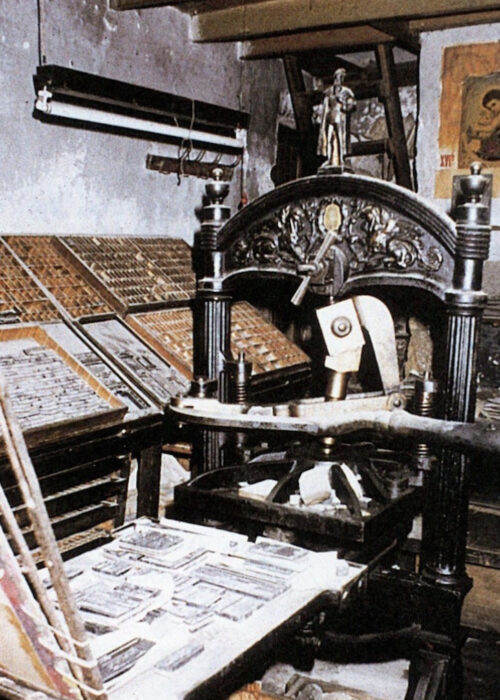
The typographic method (letterpress printing)
Typographers had their data in "boxes", which had separate cases for each type of letter.
They formed the desired words by taking separate components and placing them together in a case. When several rows were placed, they moved them on a counter until other pages were prepared. The printing material was placed in a metal frame with strips and wooden wedges, to hold it firmly in place. Then, it was placed in the press, the components were inked and a sheet of paper was pressed on. Today, this method of traditional typography is almost extinct.
The Rotary Printing method
The principle of the roller press: The material about to be printed is transferred to one or more rollers. When these rollers are inked, the print is transferred on paper, as it directly comes in contact with them, while they rotate.
The Offset Method
Offset printing is a printing method used to reproduce text and images, but not in the usual way. It uses a photochemical process. Texts are first photographed on a special film, which is then placed on a photosensitive plate, exposed to light. This way, the text of the film is photochemically transferred to the lithographic plate, which holds the ink at the desired points, while points that are meant to stay blank, hold only water. The contents of the plate are then transferred to a rubber roller, which finally prints the paper.
The Table Printing Method
With the help of a desktop printing software (DTP software) authors and designers can create books, newspapers and magazines on the screen of a personal computer.
This software allows the designer to select the desired characters from a set of fonts, draw the pages on a computer screen, save them to a magnetic disk and then convert them to film for photosynthetic printing.
Source: tmth.gr
27/4/2021
Greek Typography
The first Greek books were printed in Italy, shortly after typography was invented, with the help of Greek scholars, who escaped from Istanbul or other areas that were held during the Byzantium era, when they fell in the hands of Ottomans.

Thus, the first entirely Greek printed book we can identify was Ἐπιτομὴ τῶν ὀκτὼ τοῦ λόγου μερῶν by Konstantinos Laskari, printed in Milan in 1476. That is when the production of other Greek books began. At the end of the 15th century, the Italian humanist Aldos Manoutios decided to print numerous ancient Greek literature works, after first securing some publishing privileges from Venice.
Just a few years later, Greek books, mainly classic editions, grammar books and religious publications, were printed throughout Western Europe: in Paris, at the University of Alcala, in Spain (1514), in the Kingdom of Switzerland (1516), in England (1543) and elsewhere. Some of these publications came directly from the hands of expatriate Greeks, such as Nikolaos Glykis, Nikolaos Saros and Dimitrios Theodosiou, who printed Greek books in Venice for two centuries (1650–1850).
In Ottoman Greece, the first Greek printing house opened its doors in 1627, in Istanbul, under the eye of Patriarch Cyril Loukari, who aimed to address the influx of papal propaganda. During the 18th and 19th century, Greek books were printed all over the Balkans (Moldavia, Iasi, Moschopolis, Kydonia, etc.), as well as in German-speaking regions (Vienna, Leipzig, etc.). Thus, typography played a very important role in the spread of the liberal ideas of the Enlightenment among the Greeks and a little later, in the spread of the Revolution of 1821.
During the Revolution of 1821, several printing houses were set up by Greek revolutionaries with the help of the Philhellenes. One of them was a French student of Korai Ambrosios-Firmin Didot (French: Ambroise-Firmin Didot, 1790–1876), who donated a fully equipped printing press to revolutionary Greece. The family of the Greek components designed by Firminos Didotos (French: Fermin Didot, 1764–1836), father of Ambrose-Firminos, were used for two centuries and are still known as “ta apla” (the simple ones)..
Even prior to the independent Greek state as we know it, the Greek revolutionaries created the "Typography of the Administration", a printing house for the needs of the administration. After several relocations and name changes, in 1862 this printing house was renamed as "National Printing House" and still, up to today, prints the Government Gazette and other state publications. Εφημερίδα της Κυβερνήσεως και άλλα κρατικά έντυπα.
Immediately after the declaration of the country’s independence, the first privately owned printing houses appeared in Greece. In no time, Greek printing houses, and especially the Athenian ones, began to grow. Some of them, such as the Printing House "O Kadmos" of Konstantinos Tombra and Konstantinos Ioannidis in Nafplio (1829–1879), the printing house of Andreas Koromilas in Aegina and Athens (1834–1884) and the printing house of Konstantinos Garbolas in Athens (1838–1844) left their own mark. During the 20th century, large printing and publishing houses were created in Athens, some of which grew into industrial units with a large number of staff (such as, for example, the printing house of the Lambrakis Group).
In the 1980s, manual and mechanical printing in Greece started to fade. A new day rises in 1980, when the daily newspapers left linotype for photosynthetic printing. Within a few years, handwriting and monotype were also extinct, as they were replaced by desktop typography. The rapid invasion of electronic printing resulted in the disappearance of the Greek books’ aesthetics tradition.
Source: wikipedia.org
26/4/2021
Johannes Gutenberg
Johannes Gensfleischzur Laden zum Gutenberg(3 February 1468) was a German inventor, printer, publisher and goldsmith, who first introduced printing to Europe with his mechanical movable-type printing press.

Though he didn’t invent mechanical movable-type himself, he was the first one to use it, in order to ultimately establish the method of book mass printing. His work started the Printing Revolution in Europe and is remembered as a milestone of the second millennium, ushering in the modern period of human history. It played a key role in the growth of the Renaissance, Reformation, Age of Enlightenment and Scientific Revolution, as well as laying the material basis for the modern knowledge-based economy and the spread of learning to the masses.
According to popular opinion, he was born in 1397 and passed away on February 3, in 1468, at the age of 71. His hometown is Mainz, in Germany and he is considered the “father” of typography. Around 1430 he moved to Strasbourg. On March of 1434, one of his letters indicated that he had relatives from his mother’s side living in the area. In Strasbourg, he started experimenting in metal working, while on 1434 he took his first steps in typography.
The trained goldsmith, member of the respective guild, experimented with wooden movable components, back in 1434. The first results appeared in 1436, when he started printing popular and religious books. In 1441, after many attempts, he finally managed, using a more improved kind of ink, to print in both sides of one paper.
In 1455, Gutenberg completed his 42-line Latin Bible, known as the Gutenberg Bible. About 180 copies were printed, most on paper and some on vellum, an extraordinary labor and his first typography product. The Gutenberg Bibleis considered the first mass production book of high aesthetics and technical quality.
Project Gutenberg, a project clearly named after him, is a voluntary effort to digitize, archive and distribute cultural works through the Internet. It started in 1971 and is, today, the oldest digital library.
Source: wikipedia.org